

Which Of The Following Is Defined As The Process Of Delivering Products And Services To Customers?
What is a business process?
A concern process is an action or set of activities that accomplish a specific organizational goal. Business concern processes should have purposeful goals, be as specific as possible and produce consequent outcomes.
Business procedure direction (BPM) is a systematic approach to improving those processes, which helps organizations achieve their business goals. If an organisation is unable to perform certain business concern processes internally due to cost or resources constraints, the company might use concern procedure outsourcing. Many organizations contract specific business organisation tasks -- such equally payroll, human resources (HR) or bookkeeping -- to a third-political party service provider.
To mensurate the success of a business procedure, organizations track the completion of different steps within the process -- i.e., benchmarks -- or evaluate the quality of the process' endpoint. When an organization determines that a business process is non achieving the desired goals or outcomes, there are several strategies it can use for improvements. For example, an organization might opt to focus on concern procedure visibility to place issues in process performance or execution.
Organizations also engage in business concern process mapping to help boost the effectiveness of their business organisation operations. Business process mapping provides a visual representation of how different processes function and gives organizations better visibility into how their business works.
Why are business processes of import?
Defined concern processes within the organization are critical to enterprise success for the post-obit reasons:
- They help organizations identify and sympathise the bodily work required to proceed the lights on and to achieve organizational objectives.
- They break that piece of work into organized, repeatable steps that workers can follow to achieve consistent outcomes.
- Using repeatable steps to produce consistent outcomes helps organizations to more accurately predict the resources they need, thereby lowering the risk of over or under provisioning valuable resource.
- The consequent, repeatable nature of defined business outcomes helps lower the hazard of employees introducing workarounds or individualized steps that tin can crusade disruptions, dull work and increase error rates.
- Existence able to better measure the efficiency and effectiveness of the individual steps within the process enables teams to identify and mitigate inefficiencies and bottlenecks to ameliorate operation; this is the foundation of continuous improvement.
- Teams are meliorate able to identify where technologies -- such as robotic process automation (RPA) -- can be used to further boost effectiveness or efficiencies.
Business process vs. business concern procedure vs. business concern function
There are numerous concepts and corresponding terms to describe the art and science of running a business, with business procedure being only one of them. Business organization procedure and concern role are 2 other frequently used terms.
Although similar sounding, they each describe unlike organizational ideas, as noted below:
A business organisation process, as previously stated, is a series of related tasks that result in a desired output; information technology is an established set of repeatable activities.
A business organization procedure is a clearly stipulated way of undertaking a business organisation process; it details the teams and individual workers responsible for each function of the process likewise as the specifications applicative to performing and completing each of those parts.
A business function is an organizational unit of measurement inside an enterprise or organisation; each business organization part has its own specific set of responsibilities and activities that it must execute to support the business as it carries out its mission and overall objectives.
Although these terms all describe concepts required to operate an organization, they are not interchangeable.
Business concern process categories and examples
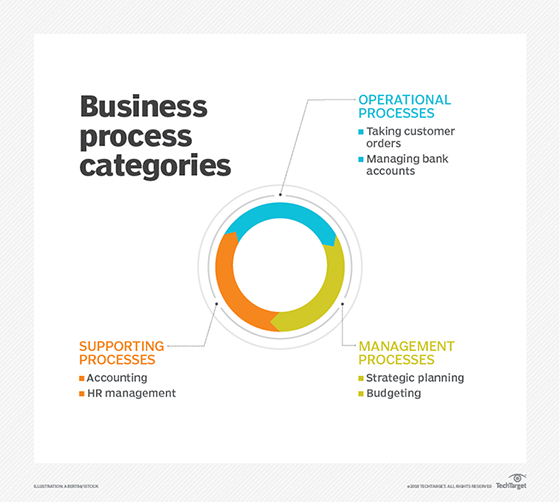
Business processes tin be categorized into different buckets, with the nigh common three equally follows:
- Operational processes. Too called main processes, these processes deal with the cadre business concern and value concatenation and evangelize value to the customer by helping to produce a production or service. Operational processes correspond essential business activities that accomplish business organisation objectives such equally generating acquirement. Examples of this include the following:
- taking customer orders
- processing production payments
- managing bank accounts
- Supporting processes. As well known as secondary processes, these involve back-part processes within the concern functions that keep the organization running. Ane key difference between operational and supporting processes is that supporting processes do non directly provide value to customers. Examples of supporting processes include the post-obit:
- accounting
- Hour management
- workplace safety
- Management processes. These processes measure, monitor and control the activities related to business procedures and systems. Similar supporting processes, management processes do non provide value directly to the customers. Some examples of management processes include the following:
- internal communications
- governance
- strategic planning
- budgeting
- infrastructure or capacity management
Some organizations and executives prefer to classify business organisation processes by business function and group them under the following titles:
- accounting and finance concern processes
- business evolution business concern processes
- HR management concern processes
- marker and sales business processes
- product delivery business concern process
Business process direction
Having established defined business processes, organizations should then engage in business organization process management.
BPM is at its core the discipline of studying and improving the business processes that exist inside the enterprise. It typically involves showtime designing and implementing the processes and and then doing the following:
- analyzing
- managing
- monitoring
- modeling
- redefining those existing processes
These activities aid organizations oversee their existing processes to ensure they are operating smoothly and producing the intended outcomes. They besides place areas for improvement and help organizations implement changes to create ameliorate processes.
BPM as well helps to identify tasks within processes that can exist automated with technologies such as RPA or entire processes that are candidates for business process automation.
Organizations apply BPM software to monitor and command automated and non-automated business processes and to assistance improve their existing processes.
BPM and the utilize of BPM software deliver numerous benefits by lowering the risks of the following:
- errors and bottlenecks that can disrupt the flow of processes;
- redundant activities within processes; and
- wasted resource.
They likewise help practice the following:
- ensure good workflow management;
- minimize costs;
- create and maintain visibility into the processes;
- amend collaboration amongst teams that share processes or have business process handoffs;
- increase productivity;
- enable agility;
- ensure compliance; and
- heave efficiency.
Business procedure monitoring
1 piece of BPM is business process monitoring. More than specifically, business process monitoring is the measurement and analysis of process performance.
Organizations typically use analytics and monitoring software for this activeness to runway costs, key performance indicators and procedure cycle time as well as to find errors and compliance issues.
Business process monitoring can also aid improve business process visibility by identifying possible issues.
Organizations use functional monitoring to appraise the functional functioning of a procedure.
Technical monitoring helps measure the technical efficiency of an application by supervising and logging aspects such equally response times and downtimes.
Business concern procedure visibility
Business process visibility provides the enterprise with a full view of each of its processes. This is important because organizations with practiced visibility into their processes can more than speedily arrange business processes as market atmospheric condition and enterprise requirements change. Skillful business process visibility also helps management teams make up one's mind if their processes are however aligned with central business concern objectives and goals, and whether the accompanying procedures that aid make a procedure successful are operating accurately. This in turn boosts operational responsiveness and expedites controlling.
Business concern process modeling or mapping
Concern processes are frequently depicted visually with a catamenia nautical chart showing the sequence of required tasks and assigning certain benchmarks or decision points to each. Business process mapping or modeling illustrates pictorially, through graphs and charts, how certain processes menses into others.
Business organisation procedure mapping and workflow tin can be thought of in the following ways:
- Sequential business process. This procedure is outlined on a certificate with clear start and endpoints. When following this process map, an organization performs a series of actions in society to complete a task inside a predetermined timeline.
- Status-driven business process. This procedure does non have a strict start and endpoint. It can finish at whatsoever stage, depending on workflow changes, the nature of production or the office culture. Likewise, information technology is typical for a status-driven process to recur or wheel on the same step in the procedure.
- Parallel business process. When activities in a concern process are executed in parallel, they are carried out simultaneously. In this type of business procedure execution, the activities on all the branches must exist completed before the side by side step in the business process can commence.
History and development
The works of economist Adam Smith, academic and writer Thomas Davenport, engineer Frederick Taylor and management guru Peter Drucker have significantly influenced how organizations define and handle business processes.
Smith, the writer of The Wealth of Nations, showtime recognized how the apply of labor division -- dividing work into a fix of tasks performed by experts -- could lead to an increase in productivity.
Taylor's innovations in industrial technology resulted in organizational productivity improvements. He is credited with transforming the workplace with his ideas on organizing work, chore fragmentation and job measurement.
Drucker -- described as the father of modern management -- focused on the simplification and decentralization of processes and introduced the concept of outsourcing.
Davenport divers the business process as a set of logically related tasks performed to achieve a divers business outcome. According to Davenport, processes make upwards the structure that helps organizations complete the tasks required to produce value for its customers.
Learn how organizations are using business process automation to streamline their business operations and contain costs.

Which Of The Following Is Defined As The Process Of Delivering Products And Services To Customers?,
Source: https://www.techtarget.com/searchcio/definition/business-process
Posted by: owensrearmiend.blogspot.com
0 Response to "Which Of The Following Is Defined As The Process Of Delivering Products And Services To Customers?"
Post a Comment